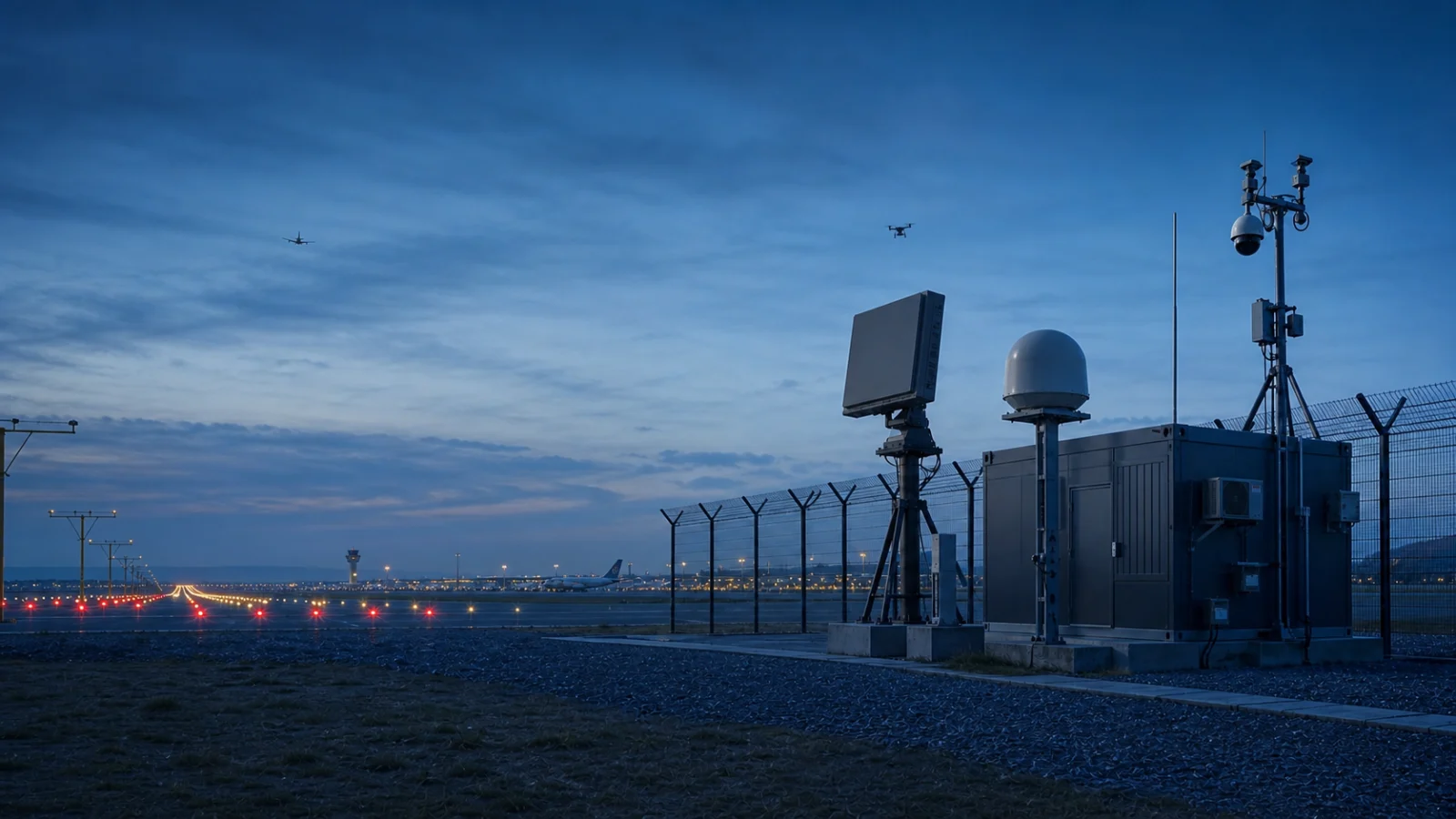
How to Design an Airport Counter-UAS System
Design an airport counter-UAS system with governance, threat assessment, RF and radar sensors, EO/IR verification, response workflows and site testing.
A practical airport counter-UAS design framework covering governance, threat assessment, sensors, command workflows, safety and acceptance testing. An airport counter-UAS system should be designed as an aviation-safety and security capability, not as a collection of sensors. The correct sequence is governance, threat assessment, operational requirements, site survey, layered detection, verified response and controlled acceptance testing. **The core design principle:** detect early, correlate multiple sources, verify before escalation and protect normal airport communications, navigation and flight operations throughout the process. Why are airports a special counter-UAS environment? Airports combine large open areas with terminals, hangars, parked aircraft, moving vehicles, navigation aids and dense radio activity. A low-altitude drone can affect runway availability and create operational disruption even when its intent is unknown. Counter-UAS technology can also introduce risk. The FAA warns that on-airport detection or mitigation deployments may affect communications, navigation equipment, air traffic operations and airport efficiency. System design therefore requires early coordination with aviation authorities, air traffic control, airport operations, law enforcement and spectrum regulators. Step 1: establish governance and legal authority Name an accountable program owner and define who can approve requirements, receive alerts, assess an incident, communicate with air traffic control and authorize each response. Record applicable aviation, communications, privacy and evidence-retention rules. In the United States, the FAA states that airports certified under Part 139 must include an approved UAS response plan in the Airport Certification Manual. The plan should coordinate airport operations, ATC, TSA and law enforcement and describe a safe return to normal operations. Detection authority and mitigation authority are not the same. Active measures that disrupt, disable or take control of an aircraft are restricted in many jurisdictions. Do not place an active effector into the baseline design until the operating organization has explicit written authority. Step 2: build an airport-specific threat model Map the assets and consequences that matter: active runways, approach and departure paths, taxiways, aprons, fuel storage, terminal crowds, air-navigat…