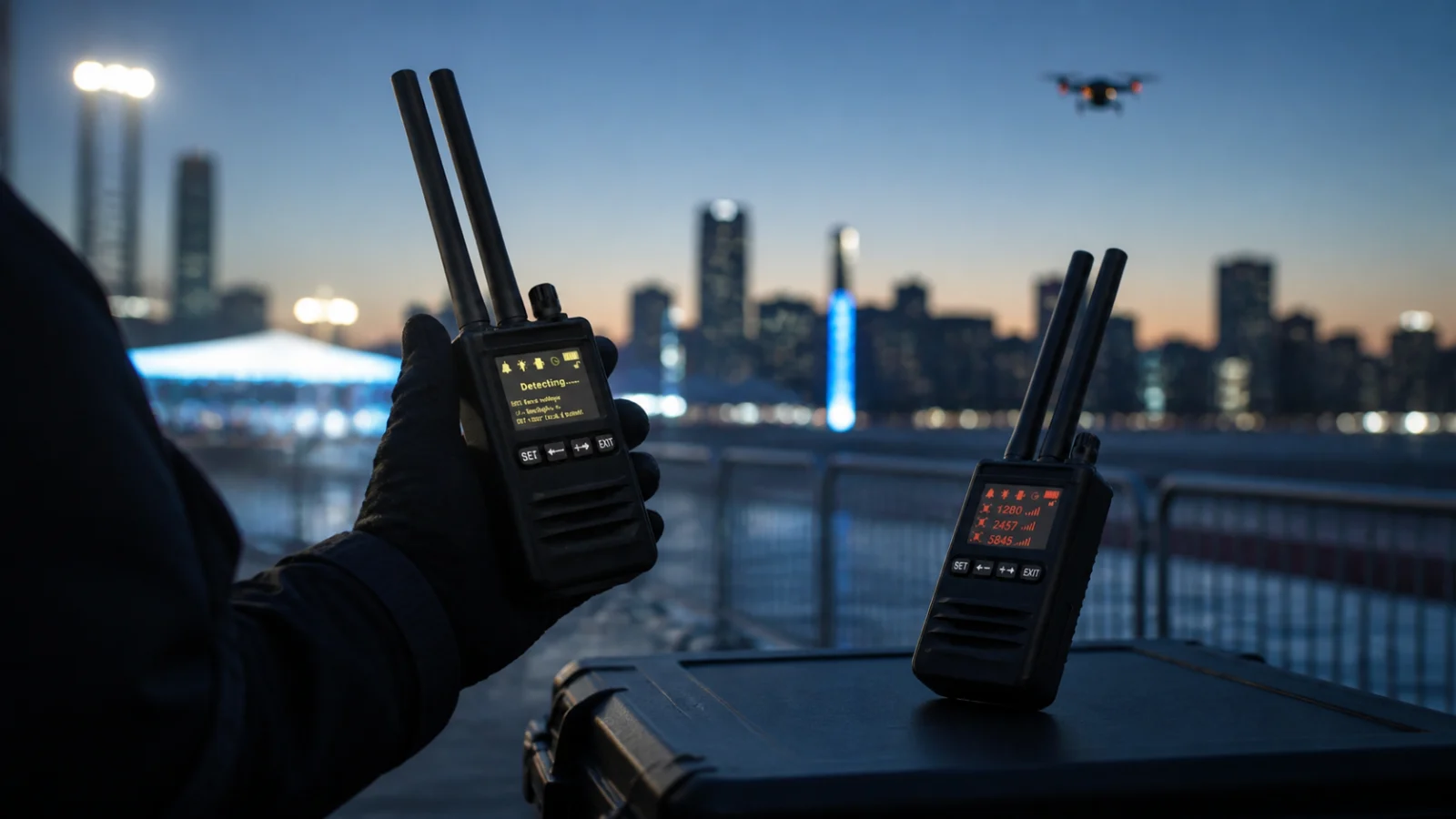
Handheld Drone Detector Buying Guide: 7 Checks Before You Buy
Compare handheld drone detectors by RF coverage, identification, pilot location, alerts, battery life and test evidence before requesting a quote.
Compare handheld drone detectors by RF coverage, identification, pilot location, alerts, battery life and test evidence before requesting a quote. A handheld drone detector is useful when a patrol team needs portable warning and a clear next action. Choosing one starts with the information an operator needs: an RF alert, a supported aircraft identity, a direction, or a reported position. These are different capabilities and should appear separately in a quotation. Use these seven checks to build a shortlist. This guide focuses on purchasing portable receivers; the [drone detection equipment overview](/en/drone-detection) covers the wider product category. 1. Specify the patrol task and required output Describe the operating area, shift length, background radio activity and who receives the alert. A walking patrol, temporary checkpoint and permanent control room need different workflows. Decide whether the operator must only receive a warning or also preserve an event record for a supervisor. Requested output What to verify Signal alert Which signals trigger it and how uncertainty is shown Identification Supported models, protocols and software version Direction Bearing method and conditions under which it is valid Position Whether coordinates are reported, measured or estimated Event record Export format, timestamps and offline access An audible warning does not automatically include identification or location. Ask to see every required output on the actual device. 2. Separate frequency coverage from recognition A wide receiver tuning range describes where the equipment can listen. It does not establish that every signal in that range can be recognized as a drone. Request the supported signal list, antenna configuration, scan settings and library update policy. A broad scan and a focused monitoring mode may behave differently. Compare them using the configuration intended for your patrol, rather than mixing the best figures from different modes. Keep detailed spectrum questions in the [drone frequency-band guide](/en/articles/commercial-fpv-drone-frequency-bands). 3. Ask what “pilot location” means US Remote ID distinguishes standard-drone control-station coordinates from an add-on module’s take-off coordinates. See [FAA guidance](https://www.faa.gov/uas/getting_started/remote_id). For any location feature, ask the supplier to iden…