Passive Drone Detection: Capabilities and Limitations
Understand passive RF drone detection, Remote ID, direction finding, localization, blind spots and when to combine RF with radar and EO/IR.
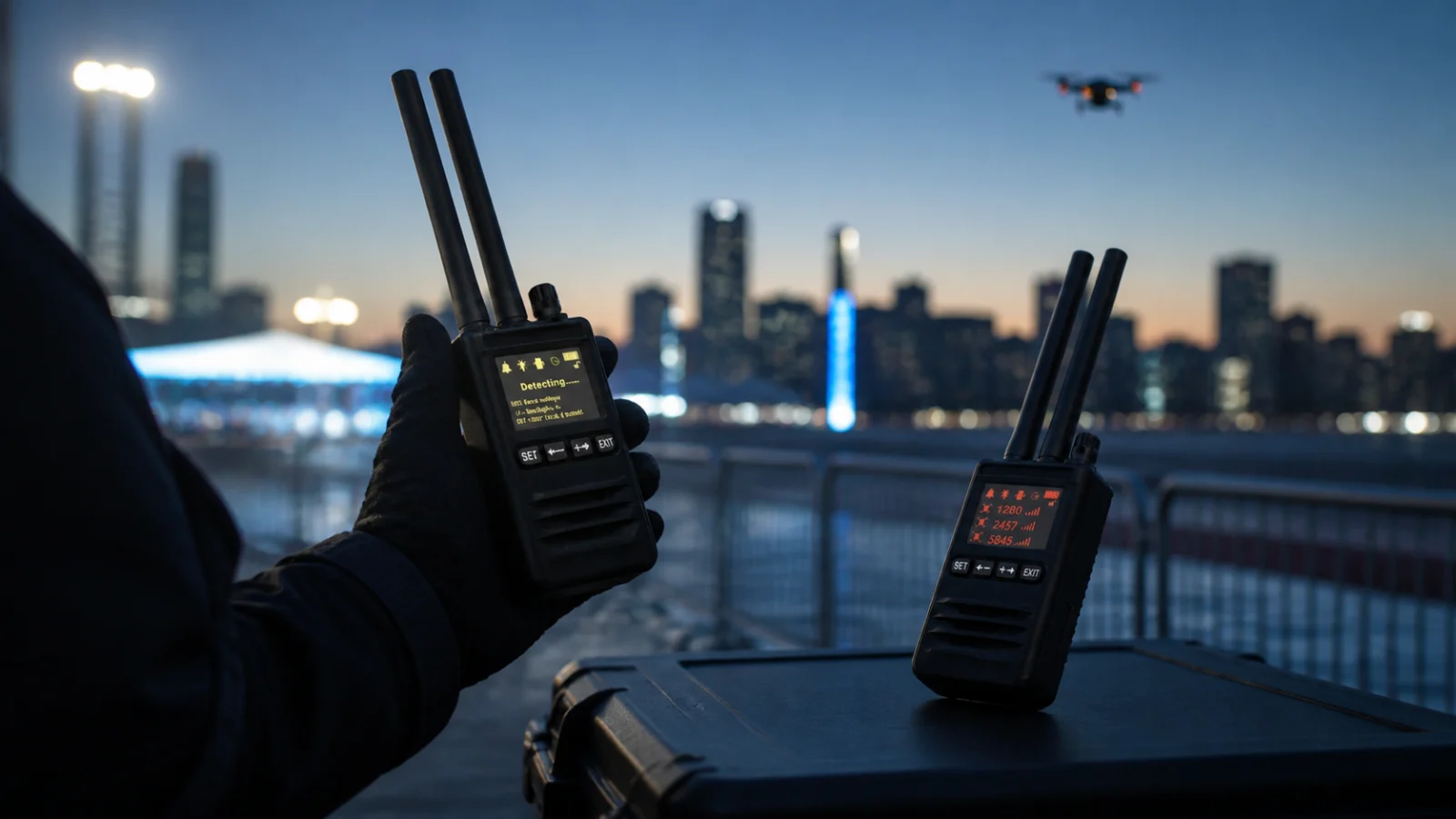
Learn what passive RF drone detection can identify, locate and track, where it can fail, and when radar, Remote ID or EO/IR should be added. Passive drone detection monitors radio emissions without transmitting a radar or interrogation signal. It can provide early warning, signal context, direction finding and—in some architectures—drone or controller location. Its main limitation is fundamental: it can only observe signals that reach the receiver and can be detected or classified. **The practical conclusion:** passive RF detection is a valuable low-emission layer for common transmitting drones, but it is not a complete counter-UAS system. High-consequence sites should plan for RF-silent, autonomous, unfamiliar and cluttered scenarios with complementary sensors and operator verification. What does “passive” drone detection mean? A passive RF sensor receives energy already present in the environment. Unlike radar, it does not transmit a probing waveform. The system may measure spectrum occupancy, extract signal features, recognize known protocols, decode permitted broadcast information or compare observations across multiple receiving stations. Passive operation is attractive where added emissions are undesirable or rapid deployment is needed. It does not mean the device has unlimited range or can identify every radio source. What can passive RF detection provide? Capabilities vary significantly by product and legal configuration. A system may provide: an alert that a likely drone-related signal is present; frequency, bandwidth and signal-strength context; classification against a known signal library; estimated drone family or link type; direction of arrival; cooperative Remote ID information; estimated aircraft or controller location from multiple sensors; track history and cueing for an EO/IR camera. Ask suppliers to separate detection, classification, identification, direction finding and localization in their specifications. These are different performance claims. Energy detection vs protocol-aware detection Energy or spectrum detection looks for activity with selected characteristics. It can observe unfamiliar emissions but may struggle to decide whether they come from a drone, Wi-Fi access point, camera or other equipment. Protocol-aware detection looks for known structures or messages. It can provide richer identification and reduce nuisan…